FAA Advisory Circular 43.13-1B
Acceptable Methods, Techniques, and Practices
Aircraft Inspection and Repair
AC 43.13-1B | 4. Metal Structure, Welding, and Brazing | 5. Welding and Brazing | 4-88. Brazing
9/27/01
AC 43.13-1B CHG 1
(3) The torch can be shut off simply by
closing the acetylene off first and allowing the
gas remaining in the torch tip to burn out.
Then turn off the oxygen valve. If the torch is
not to be used again for a long period, the
pressure should be turned off at the cylinder.
The hose lines should then be relieved of pres
sure by opening the torch needle valves and
the working pressure regulator, one at a time,
allowing the gas to escape. Again, it is a good
practice to relieve the oxygen pressure and
then the acetylene pressure. The hose should
then be coiled or hung carefully to prevent
damage or kinking.
(4) Soft soldering is used chiefly for copper,
brass, and coated iron in combination with
mechanical seams; that is, seams that are riv
eted, bolted, or folded. It is also used where a
leak-proof joint is desired, and sometimes for
fitting joints to promote rigidity and prevent
corrosion. Soft soldering is generally per
formed only in very minor repair jobs. This
process is used to join electrical connections
because it forms a strong union with low elec
trical resistance.
(a) Soft solder gradually yields under a
steadily applied load and should not be used
unless the transmitted loads are very low. It
should never be used as a means of joining
structural members.
(b) A soldering iron is the tool used in sol
dering. Its purpose is to act as a source of heat
for the soldering operation. The bit, or work
ing face, is made from copper since this metal
will readily absorb heat and transmit it to the
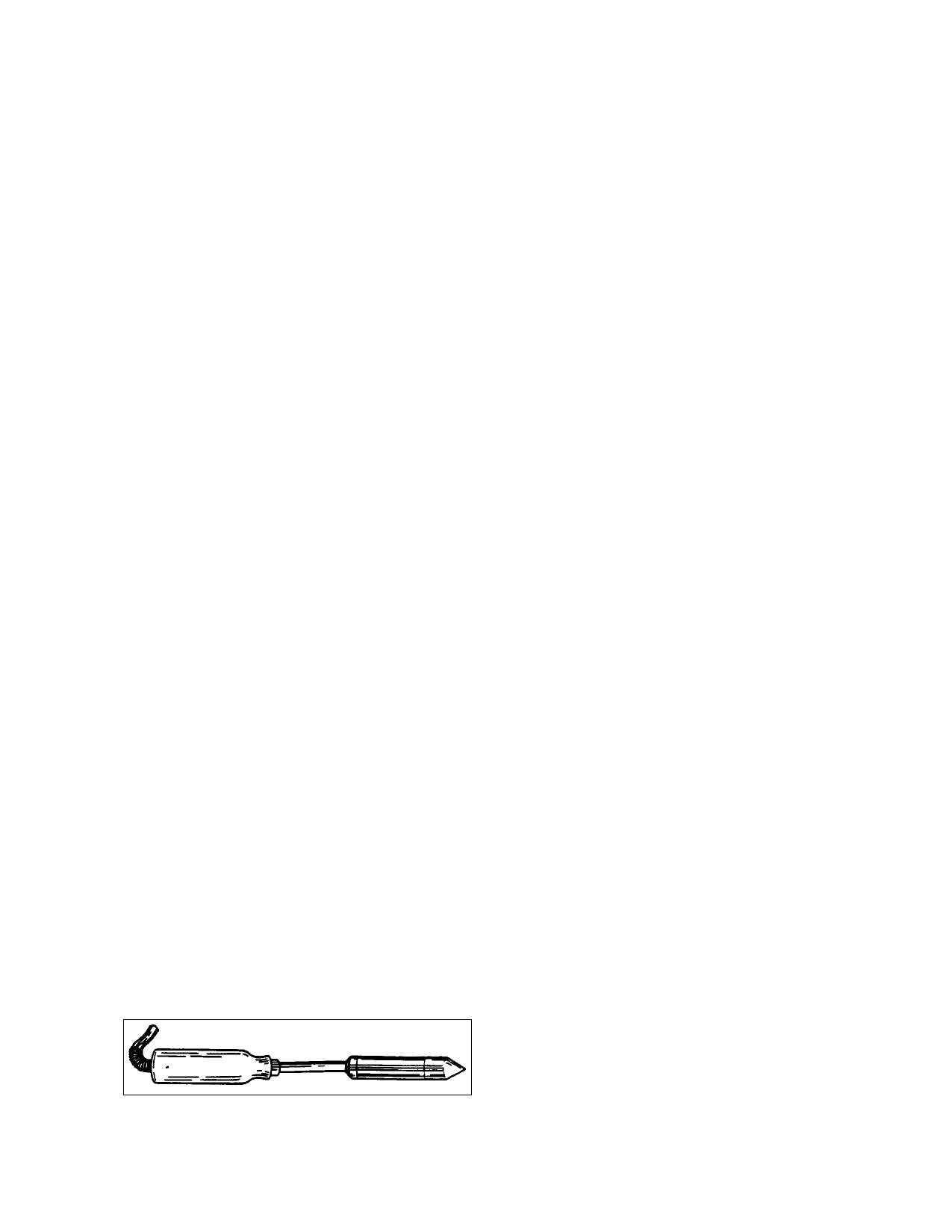
work. Figure 4-33 shows a wedge-shaped bit.
FIGURE 4-33. Electric soldering iron.
(c) To tin the soldering iron, it is first heated
to a bright red, and then the point is cleaned
(by filing) until it is smooth and bright. No
dirt or pits should remain on its surface. After
the soldering iron has been mechanically
cleaned, it should be reheated sufficiently to
melt solder and chemically cleaned by rubbing
it firmly on a block of sal ammoniac (ammo
nium chloride). Rosin flux paste may also be
used. Solder is then applied to the point and
wiped with a clean cloth.
(d) A properly tinned copper iron has a thin
unbroken film of solder over the entire surface
of its point.
(e) Soft solders are chiefly alloys of tin and
lead. The percentages of tin and lead vary
considerably in various solder, with a corre
sponding change in their melting points, rang
ing from 145-311 °C (293-592 °F).
Half-and-half (50/50) solder is a general pur
pose solder and is most frequently used. It
contains equal proportions of tin and lead, and
it melts at approximately 182 °C (360 °F).
(f) The application of the melted solder re
quires somewhat more care than is apparent.
The parts to be soldered should be locked to
gether or held mechanically or manually while
tacking. To tack the seam, the hot copper iron
is touched to a bar of solder, then the drops of
solder adhering to the copper iron are used to
tack the seam at a number of points. The film
of solder between the surfaces of a joint must
be kept thin to make the strongest joint.
(g) A hot, well-tinned soldering copper iron
should be held so that its point lies flat on the
metal (at the seam), while the back of the cop
per iron extends over the seam proper at a
45-degree angle, and a bar of solder is touched
to the point.
As the solder
Par 4-88
Page 4-61